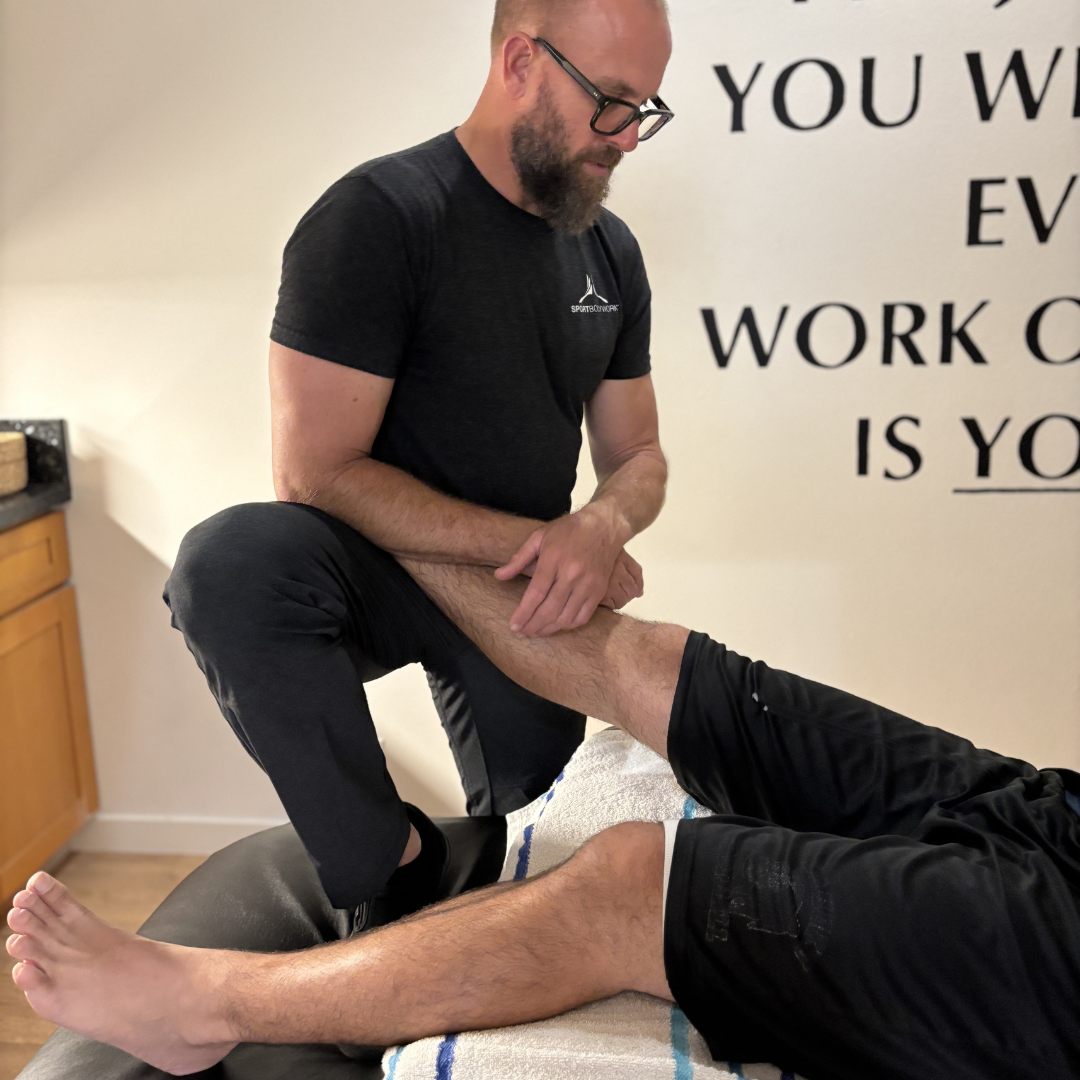
When you are dealing with an injury, recurring pain, muscle imbalance, joint restriction, or a problem that keeps coming back, you usually need more than massage.
Massage can be helpful. Chiropractic care can be helpful. Physical therapy can be helpful.
These are all good tools to have in your toolbox.
But sometimes you are dealing with a specific problem that needs a specific kind of tool.
Think of it this way: if something in your house keeps breaking in the same spot, you probably do not need to keep tightening the same screw over and over. You need to find out why that spot is under stress in the first place.
Is something pulling on it?
Is something out of balance?
Is another part not doing its job?
Is the same pressure being repeated every day?
The body works the same way.
When pain keeps coming back, the painful area is not always the whole story. It may just be the place where the stress is finally showing up.
That is why it helps to look at the big picture: how you move, where your body is restricted, what muscles are overworking, what muscles are not doing their job, and what daily habits may be keeping the problem alive.
The goal is not just temporary relief.
The goal is to understand what is happening, get out of pain, and learn how to keep the issue from coming back.
The Place That Hurts Is Not Always the Source
Pain is information.
It tells us something needs attention. But it does not always tell us the full story.
Your low back may hurt because your hips are not moving well.
Your knee may hurt because your foot, ankle, or hip is changing the way you walk.
Your shoulder may hurt because your neck, ribs, or posture are putting extra stress on it.
Your wrist may hurt because your forearm, shoulder, or neck is part of the pattern.
This is why chasing the painful spot can be frustrating.
You may feel better for a few days, but then the same issue comes back. Not because the treatment did not help, but because the pattern feeding the pain is still there.
Instead of only asking, “Where does it hurt?” it helps to ask better questions:
Why is this area under stress?
What movement pattern changed?
What is compensating?
What is restricted?
What is weak, overworked, guarded, or not firing well?
What needs to change so the body stops feeding the same problem?
That is where the solution starts.
Compensation Is Helpful Until It Becomes the Problem
The body is smart.
When something hurts, your body finds a way around it. You limp. You shift your weight. You stop using one side as much. You tighten up to protect the injured area. You change how you sit, stand, walk, work, or exercise.
At first, this is useful. It helps you keep going.
But compensation has a cost.
Your body is like a team. If one player stops doing their job, another player has to cover for them. That can work for a while. But eventually, the backup player gets tired too.
That is when a small issue can turn into a bigger pattern.
A hip problem can become a back problem.
A foot or ankle problem can become a knee problem.
A shoulder problem can become a neck problem.
A posture problem can become a headache problem.
Compensation creates more compensation.
That is why it helps to look at the body as a system.
You May Need a More Specific Tool
Massage, chiropractic care, physical therapy, strength training, stretching, rest, and movement can all be helpful.
The question is not, “Which one is good and which one is bad?”
The better question is:
What does your body need right now?
Sometimes you need hands-on manual therapy to release a restriction.
Sometimes you need assessment to figure out why the problem keeps coming back.
Sometimes you need corrective movements to help the body hold the change.
Sometimes you need a better resting position so your body can decompress.
Sometimes you need to change the way you sit, stand, walk, work, or train.
Often, you need a combination.
Bringing several pieces together in one guided process can make the work more effective: assessment, manual therapy, movement education, corrective movements, and practical recommendations for daily life.
The goal is not just to help you feel better for an hour.
The goal is to help your body work better.
One Process That Works Well: ACE
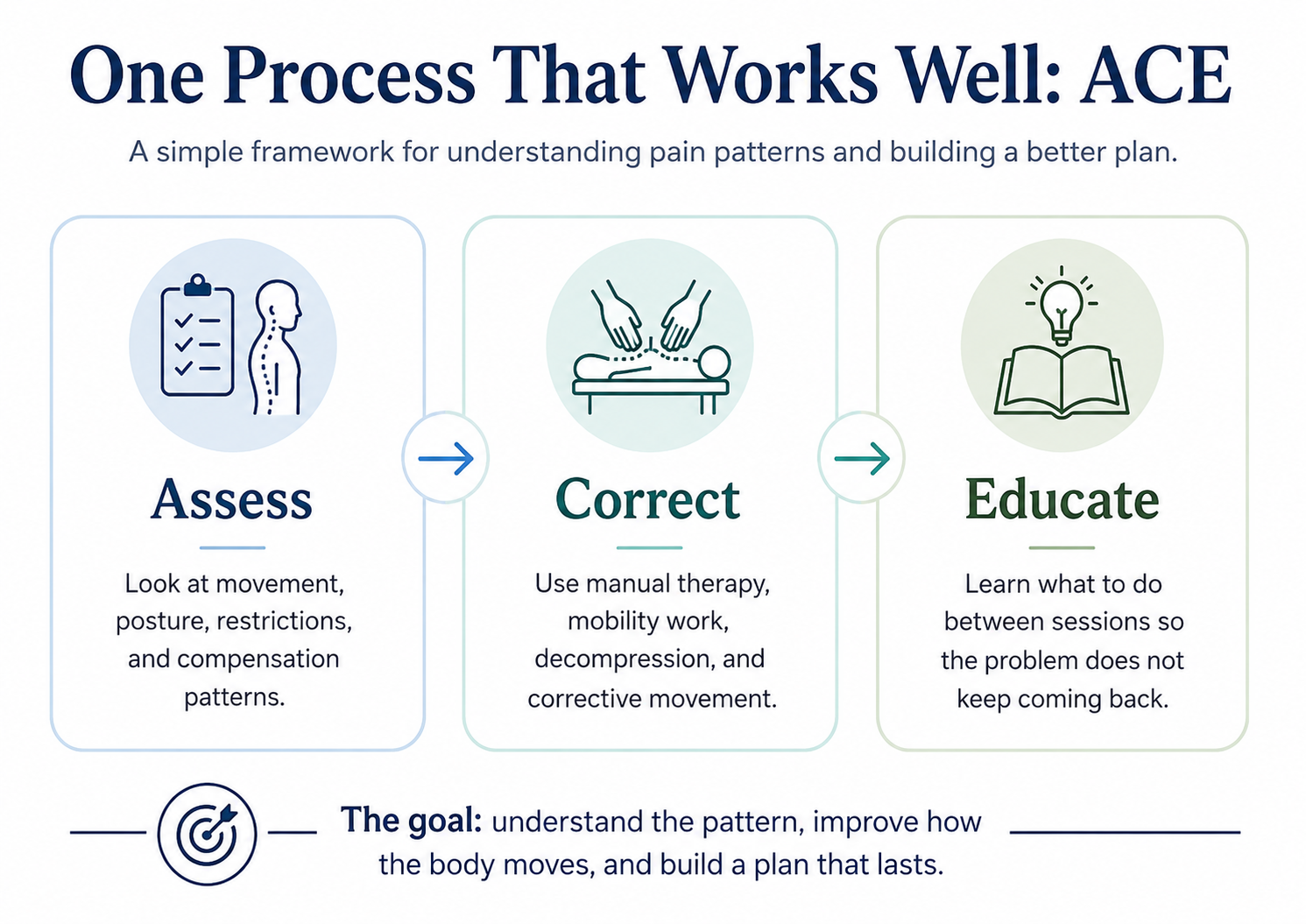
One process that works well is ACE.
That stands for:
Assess. Correct. Educate.
First, assess.
Look at baseline movement, posture, restrictions, compensation patterns, and how the body is organizing itself around the pain. The goal is to understand what is contributing to the problem, not just where the symptoms are showing up.
Then, correct.
This may include hands-on manual therapy, mobility work, positional changes, decompression, and movement-based techniques to help the body release restriction and move better.
Then, educate.
This is the part many people are missing. You need to understand what to do between sessions. You need to know what positions help, what movements to practice, what habits may be feeding the problem, and what your body needs next.
Because what happens outside the session matters.
If you feel better after treatment but go right back into the same movement pattern, the same posture, the same compensation, and the same daily stress on the body, the problem may return.
Education helps you participate in your own recovery.
Injuries Have Phases
Every injury has phases.
The first phase is the acute phase. This is right after the injury happens. You may notice pain, swelling, bruising, inflammation, or a clear change in how the body feels.
The next phase is the chronic phase. This happens when the injury changes how you move.
Maybe you limp.
Maybe you avoid one side.
Maybe you brace.
Maybe you stop rotating.
Maybe you stop using your hip, shoulder, ankle, or spine the way it was designed to move.
This is where compensation starts to become a pattern.
The final phase is the degenerative phase. This is when the issue has been present long enough that there may be more lasting changes in the tissue or joint. This can include things like joint wear and tear, loss of mobility, bone spurs, or areas of the spine becoming stiff and less able to move segment by segment.
The earlier you interrupt the pattern, especially in the acute or chronic phase, the better chance you have of helping the body recover before the compensation becomes deeply ingrained.
Pain is information.
Changed movement is information.
Recurring tightness is information.
A problem that keeps coming back is information.
The sooner you understand the pattern, the sooner you can build a better plan.
Decompress, Move Better, Heal Smarter
A big part of helping the body heal is learning how to decompress.
Most people think of core strength as crunches, sit-ups, planks, or bracing hard.
But one of the first jobs of the core is not to make you smaller.
It is to help create length.
Imagine becoming two inches taller.
Not stiff. Not forced. Just longer through the spine. More space from the hips through the rib cage. More length through the back of the neck.
That is the feeling you are looking for.
When the deeper core muscles work together, they help support the spine, reduce unnecessary compression, and give the body a better position to move from.
This matters because many painful patterns happen when the body is collapsed, compressed, guarded, rotated, or compensating.
Here are three principles that can help.
1. Find and Use Your Core
Using your core does not mean flexing your spine or bracing as hard as possible.
It means learning how to create length and support.
When you can find that deeper core support, your body has a better foundation. You can stand taller, sit better, move with less compression, and reduce the stress that keeps feeding painful patterns.
This is not about perfect posture.
It is about giving your body a better starting point.
2. Decompress at Rest
Rest is not just doing nothing.
Rest is when your body has a chance to heal.
If you can learn how to rest in a position that helps decompress your spine and reduce pressure on irritated areas, that resting time becomes part of your recovery plan.
This may include specific resting positions with pillows or support.
The goal is simple: help your body spend more time in a position that allows pressure to decrease, circulation to improve, and healing to happen with less effort.
You do not have to overhaul your whole life to start.
Start with one thing: spend 20 minutes a day in a position that helps your body decompress.
Small daily inputs matter.
3. Decompress at Work and Play
Most of life happens upright.
You sit, stand, walk, drive, work, train, lift, garden, paddle, surf, golf, run errands, or take care of your family.
When your body is vertical, gravity is acting on it.
If you are collapsed through your spine, sitting on your tailbone, standing in a compensation pattern, or moving from a compressed position, pain may keep returning.
That is why it helps to bring decompression into daily life.
You may need to sit on your sits bones instead of your tailbone.
You may need to walk taller.
You may need to change how you stand at work.
You may need to adjust how you train.
You may need to notice when your body is collapsing back into the old pattern.
These changes may seem small, but small things repeated every day are powerful.
Your body adapts to what you do most often.
Healing Is Not a Straight Line
A good day does not mean the injury is gone.
A bad day does not mean you are back at the beginning.
Healing is usually measured by the trend, not the moment.
You may feel better, then have a flare-up. You may improve for a week, then hit a plateau. You may add movement and feel stronger, then have a day where symptoms come back.
That can be frustrating, but it does not always mean you are going backward.
The better questions are:
Are your bad days less intense?
Are your flare-ups shorter?
Are you recovering faster?
Can you do more before symptoms show up?
Are you learning what helps and what makes it worse?
Are the low points getting better over time?
If the overall trend is improving, your body is moving in the right direction.
This matters because people often give up too early. They think one bad day means nothing is working.
But healing is a process.
The goal is not perfection every day. The goal is progress over time.
Why Guidance Matters
When you are injured or dealing with an imbalance, it can be hard to know what to do.
Should you stretch it?
Strengthen it?
Rest it?
Keep moving?
Stop moving?
Push through?
Back off?
The answer depends on what is actually happening in your body.
That is why guessing can be frustrating.
You may stretch something that already has too much tension on it.
You may strengthen the area that is already overworking.
You may rest too long and lose mobility.
You may keep exercising through a compensation pattern that makes the issue worse.
The right guidance can help you make better decisions.
It can help you understand what your body needs right now, what to avoid, and what to work on next.
A good wellness plan may include hands-on treatment, corrective movements, decompression positions, posture changes, activity modifications, or simple daily habits that support healing.
The goal is not to overwhelm you.
The goal is to give you the right next step.
Start With Understanding the Pattern
If you are dealing with pain, injury, restriction, recurring tightness, or an imbalance that is affecting your life, you may not need another random stretch, another guess, or another temporary fix.
You may need a better plan.
Start by asking:
What keeps coming back?
When does it show up?
What movements make it better or worse?
What positions give relief?
What daily habits might be feeding it?
What has helped in the past, and why did the problem return?
You are not broken.
Your body may just need the right information, the right treatment, and the right tools.
If you need help figuring out your specific issue, we would love to help you find the answer. And if you have already been in before but feel ready to work through the rest of the system, an assessment call is a good next step to see if our coaching program is the right fit.
The goal is simple: understand your body, build a better plan, and keep moving forward.